Girona: Game of Thrones Apartment

IMG_0861

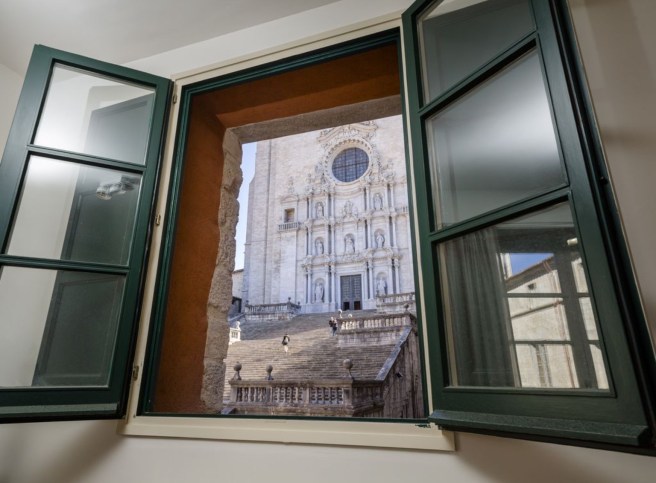
“You know nothing, Mark Hale!”  I suspect I’ll hear that a lot this September. We’ll be staying in Girona, Spain where Game of Thrones, Season Six was filmed. There was an apartment on the river I really liked. Donna kept coming back to the one with the spectacular view of the Girona Cathedral.

“You know the cathedral bells are going to ring all night long?”

“Yes.” 

“It’s going to be loud!”

“I know, but it’s so cool!”

“It has air conditioning?”

“Yes! I think so.”

“We like this one because….?”

“You know nothing, Mark Hale!” 

IMG_0872

When it comes to the Game of Thrones she is correct. My opinion? Too much exposition, and not enough action. So, I pay attention during battle scenes, sword fights, and whenever the dragons make an appearance.

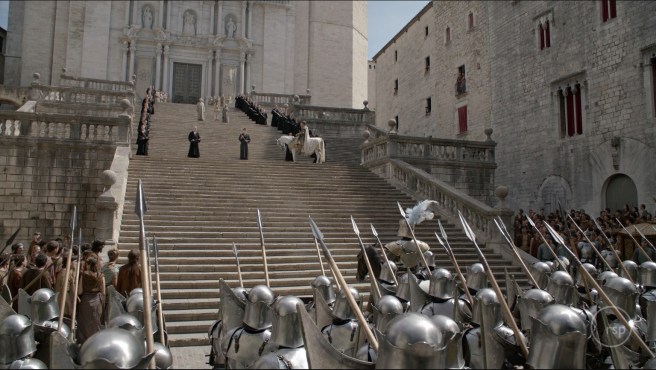
I had to look up which scenes were shot in Girona. Good thing too. My guesses were dead wrong. Girona stands in for the free city of Braavos. Margaery’s atonement was filmed on the steps of the Girona Cathedral. The Waif and Arya met when Arya was begging on the steps of Calle del Bisbe Cartana. Arya jumped out of a window and landed on an orange cart near the steps of Sant Domenec. The theater scenes were filmed in the Plaza del Jurats. The maester’s citadel is Sant Pere de Galligants.

IMG_0862

We’ll be in the heart of all that for the month of September. I am in favor of the self-guided tour. I’ll even purchase the tour book. We’ll be guided by Google Maps. We’ll probably get lost. I’ve promised not to jump out of any windows onto orange carts. Donna promises to continue saying, “You know nothing, Mark Hale!”  I’m working on a rejoinder, but it won’t be from Game of Thrones. I wasn’t paying very close attention.


Blue Grouse House Sit

THIS!

All I really need to write is, “This!”  It wouldn’t satisfy anyone’s curiosity, or inform any one.  “This!” tells a different tale entirely.  It’s a tale about the universe putting you where you need to be.  It’s a tale of connection.  So, before you read any further…push play!

 Trusted House Sitters

What got us interested in Trusted House Sitters was the need to have someone take care of our aging dogs. Being gone longer than a weekend had become problematic.  Sally and Tava had us fine tuned to their needs.  Kenneling, even with people they knew and trusted, put Tava into Alpha Dog food guarding mode.  Sally was prone to panic attacks.

Family and friends were called upon for quite a few trips, but that’s an ask that wears out its welcome.  Longer trips required someone for whom the experience of living in our space and communing with our beasts would be an ample return.  It had to be someone with old dog experience. Someone who could fine tune themselves to our dogs’ needs.

The way things worked out Sally and Tava were gone before we used Trusted House Sitters. They spent their last days with us at the island doing things they loved. It broke our hearts.  For the first time in my adult life I was without the companionship of a dog.  Trusted House Sitters became a solution to another need.

We were to take care of Beau.  As fate would have it he spent his last days in the care of his loving owners in a place truly made for a dog like him.  

Trusted House Sitters  is about connection.  Connection with a well-loved member of a household.  Connection with their family, and connection with a place.  Beau had moved on, but his absence was felt.

IMG_9603

Jess and Vikki’s Place

I hadn’t realized how much the constant chatter of life in the city and politics rattled  my existence.  Newscasts have become a marathon version of “Waiting For Godot”.  Someone should say, or do, something substantial.  It’s more like the crows in our neighborhood’s Monkey Puzzle Tree.  They squawk and swoop. They won’t go away unless you look them in the eye and demand it.

Up on the top of the world at the Wright’s place, it isn’t immediately clear why the useless chatter wasn’t asked to depart a long time ago.  Donna and I are meadow people.  We like a view that extends all the way to the horizon.  It gives you room to breathe. This in turn gives you room to let the chatter fall away. 40 acres of elbow room does a lot for the soul.

My constant complaint about traveling to far away places is that most of the buildings we visit are disconnected from the people who actually built them.  I want to know about the craftspeople.  Who designed the building?  Who chose the materials?  Who shaped the materials into a thing of beauty? Who gave the building life?  The aristocrats listed in the guide books seldom lifted a finger. They are the focus of every tour. History after all is the refined practice of name dropping.

Jess and Vikki’s house lives on a more real plane.  If you have done any building, you recognize the care that went into every decision, and every board.  The connection between people and a building turn a place into home.  There were no abstractions here.  I shook the hands that made this place a reality.  I’ve experienced the gilded cages of Versailles.  I’d rather be up on Blue Grouse watching the sky unfold before us.

Things You Can Do in Oroville

Oroville sits perched at the top of Okanogan County next to the Canadian Border.  As a kid my family used to make the four day trek from Seattle to Tulia, Texas.  We passed through a lot of towns like Oroville.  Most of those towns have been lost to interstates, strip malls, Mickey D’s, and big box stores.  Oroville feels like a throwback to an earlier time.  Maybe not the 50’s, but homogenization hasn’t completely taken control.  It’s still a town with character.

Vicky’s Back Door probably isn’t in any visitor’s guides.  It’s a do-it-yourself dance hall, help yourself  to popcorn, there’s beer in the fridge and wine on the counter kind of place. The crowd and the band were local.  Line dancing was the order of the day.  The people were friendly, and it didn’t take long for Donna to get me out on the dance floor.  We didn’t line dance, but we performed our signature move.  When the “We never go dancing!” conversation comes up” I can say, “Yeah, we danced in Oroville.  Remember?” 

Before we went dancing we had dinner and beers at The Pastime Bar and Grill. We had prime rib.  It was the best piece of meat I’ve had outside of Texas.  I’ve been to quite a few highly touted BBQ joints in Seattle.  There’s some folks down in Seattle’s Georgetown who think they are the epitome of bearded hipster pit masters.  They don’t hold a candle to the folks at The Pastime.  The prime rib was medium rare and perfectly seasoned with smoke.  The Naughty Potatoes balanced on a fine line between Heaven and Sin.  My list of the world’s top flavors includes Single Malt Scotch, Humbolt Gold Oysters, Cuban Cigars, and Cooper’s Brisket.  The list has been expanded.

The Highway 97 wine trail in Canada is worth exploring.  From Osoyoos to Oliver there are there are 39 wineries.  Tastings run from free to $6 per person.  We sampled wines at Hester Creek, Burrowing Owl/Inniskillin, Moon Curser, and Gehringer Brothers. Hester Creek has an excellent restaurant, Terrafina, that serves locally sourced Italian inspired fare.

As a rule we favor red wines, but in the Okanogan we were impressed by the whites.  They were crisp and suitably dry. When someone told you to expect notes of peach, lime, or apple you didn’t have to fake it. Those notes were there.  The reds were heavy on tannins, and what I’d call angular.  Things like roundness and velvety finishes were not easy to find.  Moon Curser’s wines were to our taste and we left with a couple of their blends.  The port style wine from Burrowing Owl  awaits the right chocolate dessert.  It wouldn’t be bad spooned over a bowl of vanilla ice cream either.

The thing about small towns is each one has a heartbeat of its own.  On Saturday night in Oroville the heartbeat was at Alpine Brewery.  Brats, beer, beans, and potato salad were on the menu.  So was a lively set by Hippies on Vacation.  Two fine guitarists, a six string bassist, and some tasty drumming held off the threatening rain.  The power of music and a breeze blowing in the right direction worked wonders.

This!

We sat in Vikki and Jess’ living room watching the sky move from sunset to twilight.  Donna was playing the parlor guitar.  I was playing my heavily used Ovation.  We started out playing Will The Circle Be Unbroken.  Donna sang the Buffy Saint-Marie songbook.  We finished up trying out a John Cale tune about life in a war zone.  Dying on the Vine is a song worthy of any Welsh poet.  It’s also a song that’s worth playing into the twilight.  The sky cooperated beautifully.  Up on Blue Grouse that’s what the sky does!

IMG_9673

Thanks to Jess and Vikki Wright! 

IMG_0792

Herron Island: The Calm in the Storm

Owning a place on an island in Puget Sound is a wonderful fantasy.  The reality is even better.  The usual Pacific Northwest island fantasy involves the fabled San Juan Islands. I could tell you I sailed through the San Juans several times. The truth is I motored through under bare poles hoping to find decent moorage, or anchorage, before 1:00 pm.  Once moored the allure of restaurants, and a decent Bloody Mary, took precedence.  The San Juans are beautiful, and crowded.

Down near the bottom of Puget Sound the restaurants and amenities are few.  Good anchorage is abundant.  The wind picks up every afternoon, and the waters surrounding Herron Island provide good sailing.  Restaurants, stores, shopping??? On holiday weekends the locals gather at North Beach and have a sale they call “Junk in the Trunk”. Herron Island is a throwback to the times when island living was simple.  A time before overdevelopment and the crowds took over.  If your idea of island living involves shopping in a quaint overpriced boutique, or quaffing a microbrew in a trendy bar, Herron Island is not for you.

Herron Island is a calm in the storm.  It involves hanging out in a hammock looking out at the East Channel.  It involves deer so tame they eat out of your hand.  They also join you at the table when the wine is poured.  From the dock you can catch squid and rock crab.  You might pull in a dogfish. The best clamming beaches are openly shared secrets.  Although, you almost never see the person who shared the secret heading their boat towards the spot they told you about.

At night it’s a seafood bounty around a campfire.  It’s homemade ice cream and brownies.  It’s your sister’s best dessert. It’s your brother’s Chilean wine.  In the morning it’s fresh coffee and blueberry pancakes. The kids are in the ravine, or up in the loft.  If it’s midweek you feel like you have the whole island to yourself.  If you are lucky a pod of Orca swims by in the East Channel.  If you are energetic, you put the kayaks in and head north to the float where the Harbor Seals congregate.

Let me tell you a story.  It was late August. When we got up it was still dark outside.  We were heading to what clam lovers call the Honey Hole.  It’s a spot where you can scoop up five clams at a time using fingers as rakes.  Low tide was at 6:30 am.  We set out in darkness. Green flashes of iridescence burst from our paddles and surrounded our kayaks.  Every drop of water was part of an aquatic light show.  As we got further from the island the sun began to rise. The sky shifted colors from deep midnight blue to purple, and then to violet, red, and a dusty pink.  In the quiet we reached the float where the Harbor Seals hang out.  The float was empty.  Then big eyed seals started popping up all around us.  Donna was so struck by the beauty she had tears in her eyes.  I paddled up and said, “I didn’t get up at the crack of dawn to miss low tide. Let’s go get some clams!” 

The thing is we didn’t see a single person out there. We didn’t see the first boat racing by until we were heading back to Herron Island. We were immersed in island living. You could hear the waves lapping against the shore.  It was just the two of us. Our kayaks were full of freshly gathered clams.

Our Herron Island adventure has never been a one season experience.  Summer, Fall, Winter, and Spring all reveal new textures and beauty.  What could be better than being curled up on the couch with rain beating on the metal roof, or watching snow drift down as the fire dances in the fireplace. All the storms that life tosses your way lift as soon as the Herron Island Ferry leaves the  mainland.  It’s always worth the visit.

This slideshow requires JavaScript.


Cuenca: A Second Look

imageThe sign in the antique shop on Calle Larga said, “Apartment for rent.”  The sleek modern place on the Tomebamba River is available next February and March. Cuenca’s much delayed electric tram is supposed to be up and running sooner instead of later. Ecuador’s elections are too close to call at the time of this posting. Political unrest? That hangs in the balance as well. What can I say? When we left Cuenca for Vilcabamba we were feeling uncertain. Has that changed?

Vilcabamba exceeded expectations. It’s Paradise shortly after the fall. In our view staying in Vilcabamba for an extended period of time would be dependent upon being able to make an easy urban escape. Loja is that destination. Within the first couple of hours in Loja Donna’s gut instincts were saying, “I’m not feeling it!” Every downside we’d heard about the place was ringing true. The upsides didn’t overcome the sense that “There’s no there there!” In the end lingering in Vilcabamba looked pretty darn good. Loja inspired the urge to escape.

Our escape from Loja took us to Saraguro. The town is named after the indigenous Saraguro people. They are one of Ecuador’s strongest and most intact indigenous groups. Local customs and culture are strong. The Sunday market is a gathering place for proud Saraguro’s dressed in their traditional finery, and for youngsters with cell phones. Many youth were dressed in the latest fashions with their long braids tying them to traditional culture.

image

The photos we took in Saraguro were discreet. We were the ones who were out of place. Our manner of dress was worthy of sidelong glances.

A woman our age, wearing a stylish fedora, pigtails, and a fleck of coconut on her face, served as a warning. “I just love the Indigenous!” She was organizing a return visit with friends. A project was in the works. Truth? The locals are probably too polite to tell you what they think of you. Just be there and soak it in. Gushing and projects aren’t necessary. The Saraguro have been doing fine for centuries. What can you possibly think you have to offer them?

At this point we’ve started discussing the possibility of using Cuenca as a base and escaping to the small towns. Yes, Cuenca’s busses still belch black smoke. We found ways to avoid them, and discovered neighborhoods where the smoke doesn’t quite reach. Cuenca is an attractive city. It has interesting architecture, great restaurants, and the river. You can rent a nice place for $500 to $800 per month. A $5 bus ride will get you to one of the small towns. From there other towns are an inexpensive taxi ride away. There is a reason so many ex-pats live in Cuenca.

image

Overall Ecuador is an intriguing retirement/snowbird option. Recent changes allow tourists to stay for six months instead of three. A Canadian ex-pat shared that high interest rates (9%) are offered by the banks. He also shared that bank accounts up to $30,000 are guaranteed by the government. Economic stability??? That’s a global issue. I’d say Ecuador’s economic climate is in flux. With that in mind it makes sense to rent a place instead of buying one.  “Keep it light enough to travel.” has always been solid advice.

Nuts and bolts and bottom lines are worthy considerations. Still, it comes down to an emotional connection. Without connection there is no reason to do the figuring. It’s a big world and the options are endless.

image

From Saraguro we caught a three hour bus ride into Cuenca. It cost $5.00 and was a nice way to travel. The landscapes were beautiful. Double rainbows greeted us as we entered town. The churches in the historic center of Cuenca were a familiar sight. It felt like coming home. In my mind that’s about as good as it gets!

image


Saraguro Sidetrip

image

Loja wore out its welcome. We had breakfast in one of its highly rated coffee shops and found Ecuador’s version of a Pancake Haus. Decent food in an atmosphere that was bright, but battered. The cappuccinos came pre-sugared and nearly foamless. Then it was back to the hotel.

The clerk at Hotel Victoria called Donna over and presented her with a hand towel from our room. There was a bit of makeup, a smear of lipstick, and a small blue dot of mouthwash on the towel. “This will cost you an extra $10 when you check out.” Ummm???

image

Donna wasn’t having any of it. Lukewarm showers, an empty hot tub, a freezing swimming pool, and a noisy room can be overlooked. Although, Hotel Victoria is supposed to have a five star rating. Charging $10 for a lipstick smear on a hand towel that’s seen better days? That’s adding insult to injury!

We were booked for two more days, but the packing started as soon as we got to our room. We were leaving Loja and heading for a hostel in the town of Saraguro. Hotel Victoria called a cab that could get us to Saraguro for $60. We hit the street. In ten minutes we secured what I am sure was an overpriced ride for $20.

Overpriced, but depending upon your viewpoint it was worth it. It was a 75 minute Andean Mountain Carnival Ride. We swooped around curves, flew over bumps, swerved just to swerve, passed trucks on blind corners, flew down hills, and eventually wound up at the wrong hostel.

Inti Wasi was the only hostel our driver knew. It was rustic, out of the way, and they weren’t expecting us. A quick consultation, a $10 necklace, and an internet connection later we discovered we were supposed to be at Achik Wasi.  $1.25 and another taxi ride got us to the right place. The right “cash only” place.

image

After we paid the hostel we had $45 left. Then the clerk showed up to exchange a torn twenty dollar bill. No one in Ecuador wants that torn twenty. We were down to $25. Fortunately, the guidebook says there’s lots of cash machines in Saraguro. We walked to town and tried them all. Unfortunately, they refused to give us any cash.

At this point we were going through our mental checklists. Then we headed to the bus station. There were two busses out of Saraguro on Sunday. Tickets were $5 apiece. Our stomachs were telling us the remaining $15 was going to leave us on short rations. That left us looking for the last cash machine in town.

The search eventually took us to a cash machine we’d already tried. It also took us to a restaurant called Shamu. They said they took credit cards. Shamu served us the best meal we’ve had in Ecuador. After ten minutes of unsuccessful attempts the folks at Shamu got one of our credit cards to work. Fed, satisfied, and paid up we snagged some buns at a bakery and headed up the hill to Achik Wasi.

I don’t know if there is a perfect ending to a day like this. The two locals testing out their prized fighting cocks on the street certainly put at cap on things. The $10 washcloth…forgotten!

image

Loja: A Work in Progress

Ok, I’ll admit that starting a blog entry about Loja with a video of a guy using a jackhammer isn’t exactly fair. We walked from one end of the town to another and found a half dozen beautiful things to photograph. You actually can take this walk without choking on clouds of vehicle exhaust. The thing is workmen are tearing up the city and not just one street at a time. Loja is a work in progress.

Loja has great coffee, plenty of green spaces, beautiful churches, a well maintained square, universities, and taxi cab drivers who will launch you into outer space as you cross the streets. They do honk at you as they press on the gas though. I experienced this as a pedestrian, and as a passenger!

imageWe are staying in one of Loja’s finest hotels. It’s polished wooden floors, iron work, and floral arrangements are a welcome respite from the construction dust of Loja’s streets. Someone from housekeeping even knocked on our door and offered us coconut macaroons. The freshly squeezed limonada in the bar was close to perfect. The Ruso Negro we tried to order ran counter to Ecuadorean laws and customs. On the day before Ecuador’s Presidential election the whole country is dry. If ever there was a time people needed to drink something stronger than a limonada, election night would be it! We checked the mini-bar in our room and decided not to pop the overpriced lager.
image

At night Loja gave us a hint of what we hoped it would be. The dirt and dust of construction was less visible. Newly installed tile sidewalks spiffed up Loja’s restaurant row. Landmarks were brightly lit. Traffic was reduced. Election night sobriety made for a dull Friday night though. The restaurant we ate in was empty save for a fiftieth birthday party upstairs. The local music spots were quiet too. Maybe a period of abstinence is what it takes to get 74% of the electorate out to vote.

image

Ecuador and the city of Loja stand ready and waiting for a new chapter to begin. Whether the holes get filled in this chapter, or remain empty has yet to be revealed. I can tell you this…as soon as the drinking ban is lifted I’ll be in the long line at the bar!

Vilcabamba: Paradise

imageAt night fireflies twinkle in the trees. At dawn bright yellow canaries streak by. That’s just from the deck! As we walk to breakfast we notice flowers we passed by the day before. After breakfast we sip coffee on a bench overlooking the town. The sun is always overhead at the equator. The effect on the view is mesmerizing. The sunlight and the clouds are constantly engaged in slow seductive tango.

In Cuenca an ex-pat from Atlanta wrinkled his nose when we mentioned Vilcabamba. “The people there are from a different planet.” It’s true, but whatever planet they drifted in from feels fairly comfortable. I’m guessing there are at least three White Boy Blues Bands in town. Think Snohomish, Washington tavern patrons dropped in the middle of an Andean valley. Then replace all the antique shoppers with Ecuadoreans  and Ecuadorian culture. “Honey, this isn’t Snohomish!”  “True, but I’m betting you could swap the Snohomish and Vilcabamba blues band bassists around  and no one would even notice.” 

image

Long and short term apartment rentals in Vilcabamba are running from $350 to $500 per month fully furnished. A couple from Illinois shared that nicer two bedroom houses are running $800 a month.

The ex-pats we met advise against buying.  “The rents are so low there is no advantage in buying. Besides people get sick and go home, or to Cuenca.  Then they can’t unload their place.” That said, a fully furnished place was selling for $144,000. A rustic hippy abode to abide in was going for $109,000. A beautiful long abandoned tear down next to the Chambra River was not moving at a half million.

image

So, what would a person do in Vilcabamba? Outdoorsy types take on the many scenic hikes in the area. Yoga classes are offered at various locations around town. You can rent horses by the hour, or by the day. Restaurant choices are varied and plentiful. Although, the corner table outside Las Terrazas is permanently occupied by grizzled extra-pats. A $7.00 machete would keep you occupied fighting back the undergrowth that threatens to swallow everything whole. Getting bored in Vilcabamba appears to be a matter of choice. If that’s what you choose a $1.25 bus ride will get you to Loja in an hour. $2.00 will get you a shared taxi ride and you can be in Loja in 30 minutes. What’s not to love?

The truth is unless you’ve stayed somewhere a month or longer you don’t really have a clue what living there would be like. I recall a lovely house in a cul-de-sac we decided to sell after a year and a half. Then there was the foodie paradise where every menu in town was identical. Well, we did find a falafel stand. They slathered ketchup and mayonnaise on their falafels. Sheesh! So, I’m reminded of some lyrics I once wrote. “Paradise has a way of closing in on you. There’s snakes in the bushes, and piranha in the pool.”  Maybe not, but sometimes you have to create your own warnings. Otherwise you might jump right in!

image

Cuenca: Where There’s Smoke

image

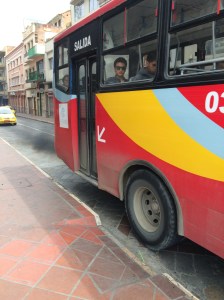
“I could fall in love with Cuenca, but…” Cuenca is a beautiful city. It has a mild climate, great restaurants, and interesting architecture. It has lovely rivers, and is nestled among striking green mountains. The people have been overwhelmingly friendly and welcoming. Cuenca is everything you could ask for. Then there are the busses that roll by belching street filling, lung hurting clouds of black smoke.

The smoke isn’t a subtle thing. When I said it was street filling I wasn’t exaggerating. People cover their faces, hold their breath, and turn away when busses roll by. When people write My Least Favorite Things About Cuenca lists bus emissions typically rank #1.

image

There is a lot of speculation about why the emissions are so spectacular. Lack of emission controls, and bad maintenance are the usual guesses. In fact there are annual inspections for all vehicles in Ecuador. Maintenance is a factor, and so is the fuel.

Ecuador still uses diesel that is 500 ppm sulfur instead of the Ultra Low Sulfur Diesel that is 15 ppm. The sensation of feeling like you are going to vomit when a bus rolls by can be attributed to the sulfur. Not all busses emit heavy clouds of black smoke though. This comes down to the age of the bus, engine wear, and how the bus has been tuned. In some cases busses have been adjusted to run rich. This generates more power, and more smoke.

It would be easy to assume the air quality problem is being ignored. This is not the case. An electric trolley system was being built, but stalled due to a lack of funding. Two Eco-Busses were added to Cuenca’s fleet. Again, a lack of funding has prevented the purchase of additional Eco-Busses. The discussion at the city council level is ongoing. The discussion among the ex-pat community ebbs and flows. When air quality comes up there’s no shortage of opinions.

image

According to the 14 air pollution monitors placed around town the historic center registers the worst air quality. It is possible to  hang out in neighborhoods where the pollution is less noticeable. You can adjust your walking  route to avoid the streets busses use. Let me tell you though, after it rains you get a sense of just how sweet things could be.

Cuenca is a beautiful city. It has everything you could wish for, and busses that belch black smoke.

Ecuador: Impressions

image

Observation, immersion, practice, and discussion are the basics of learning. So is admitting that a single bite of the apple will get you into trouble. We have been cautiously nibbling towards the core of Ecuador, but have only dented the skin.

In Quito we stayed up the hill from the historic center of town. The guidelines for staying safe were shared by our host, a restaurant owner, two police officers, and a cab driver. The cab driver locked all the doors as soon as she entered our neighborhood. This put me on casual alert.

The guidelines? Never set your bags down. Hang your purse strap across your shoulder and hang on tight. Don’t walk around with your passport. Carry a copy. If you are out after 8 pm, catch a cab right to your door. Don’t go anywhere alone. Lock up even if you are just taking out the garbage. It’s all sound advice.

Did we ever feel threatened? We were mindful. As gringos we stuck out like sore thumbs. We never saw another gringo when walking up Calle Cuenca to our apartment. Few people made eye contact with us first, but they returned our smiles and greetings warmly.

In Cuenca the cautions aren’t as stringent. We aren’t staying in Gringoland, but Gringos are far more common here. The Ecuadoreans are unfailingly polite.  The Gringos stare holes in you. There’s a clique that we obviously don’t belong to. It’s a clique that has hired an armed security guard to stand outside their sleek modern coffee shop.

I was curious to find out what was up. My gut told me the Gringos are creating Arizonian enclaves and jealously guarding their ability to live on a shoestring. More Gringos can only mean higher prices. Our Friday morning coffee buddy, Jerry the Aussie, said that’s part of it. When outside of Gringoland people wrap themselves in a tight bubble to minimize interactions with people on the hustle. If you want to meet Americans, you have to go to happy hour at Fabiano’s. Wearing ear plugs is advised. “Americans are really loud!” My reaction is to double my efforts to speak Spanish and venture beyond Gringoland.

So far, venturing beyond Gringoland only applies in Cuenca. Like every big teeming city, Quito’s level of poverty gives it an edgy feel. Everyone is on the hustle. 50% of all working Ecuadoreans are self-employed. Every niche is filled. As you begin to venture away from the center of the city the same enterprising spirit is evident, but it looks like a hard scrabble existence. To be sure we never saw homeless encampments like those that exist under big city overpasses in the U.S.. In Ecuador poverty appears to have an agrarian element. There are chickens in the alley, pigs tied up on a stretch of land next to the train tracks, and garden plots where time and space allow. People are surviving here, but it’s way beyond the comfort level of Gringoland.

Upward mobility appears to be purchased one concrete block at a time. The ground floor of a home is roughed in first. Once that is done blocks are stacked on the second level. Houses stand at various levels of completion. Many homes are fully built. Some have corrugated metal roofs held in place with old tires. Some have covered second floor patios. Others lack doors and have no glass in the windows. They are occupied and keep the occupants dry. What else they provide I don’t know.

I am not well versed in Ecudorean politics. The official word is that President Rafael Correa has engaged in aggressive anti-poverty programs. His support of Ecuadorean Art and Culture is evident. Crime has been greatly reduced. Education is a priority. When we ask about the upcoming elections in February the subject quickly turns to Trump. From what we’ve been able to tease out, Correa’s popularity seems to be class based. Middle class support for the soon to be ex-President doesn’t appear to be wholehearted. His human rights record has been strenuously questioned. Perhaps that explains the hesitation to discuss Ecuadorian politics.

image

We met an an exchange student from New York and had a brief exchange about the state of things at home, and in Ecuador. Trump came up. We laughed. It’s difficult to find anyone who isn’t horrified. Canadians, Chileans, Germans, Brits, Aussies, and Peruvians all express sympathy and wish us a short nightmare.

In terms of Ecuador’s upcoming election…there appears to be a slate of questionable choices. Many candidates lack the education and experience to guide Ecuador through its challenges. Several people shared that the most qualified candidate has a degree in finance. He is also noted for being a clown on Ecuadorean television. No, I am not making this up!

None of this takes away from the charm of Cuenca and Ecuador. A place is always more than it’s politics and problems. Cultural roots run deep here.  There is a pride and community that people can lean into. Ecuador is not the United States. Here the culture starts on the inside and shines through to the surface.

This slideshow requires JavaScript.

Quito: Into the Country


image

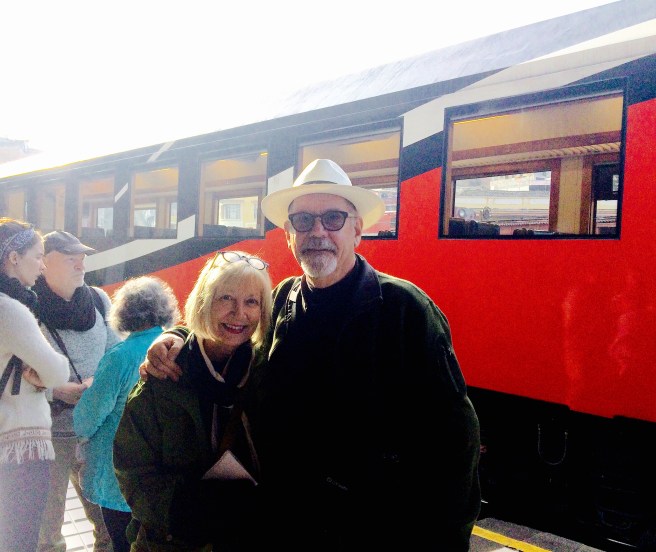
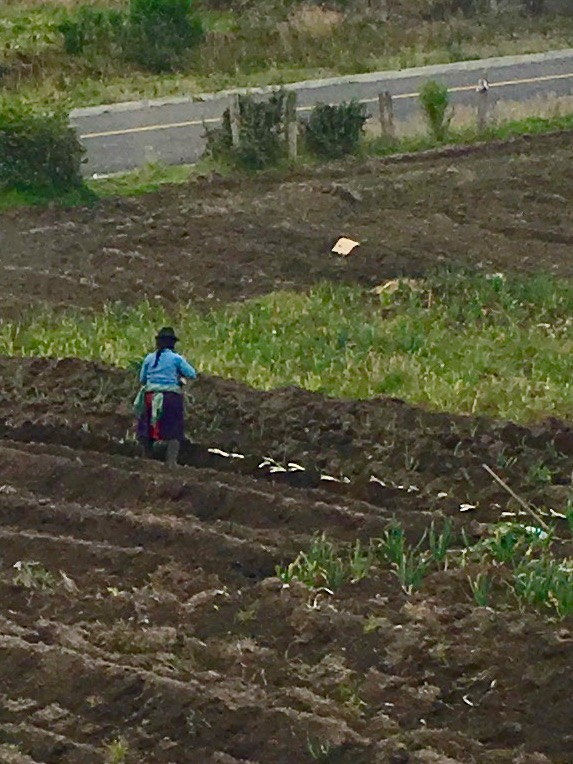
While researching modes of transportation in Ecuador I discovered Tren Ecuador. The trains were developed to serve the tourist trade. They provide guided tours to the areas surrounding Quito. After looking into all the tour options Mark and I chose the Volcanoes Tour. 

image

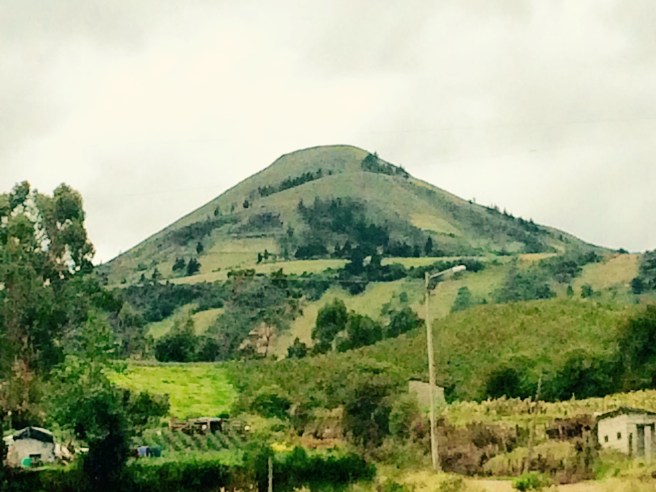
The Volcanoes Tour included at trip through the countryside outside of Quito, stops in some small towns, a hike to explore the flora and fauna around the volcano, a typical Ecudorean meal, and a visit to a local farm.

img_8470

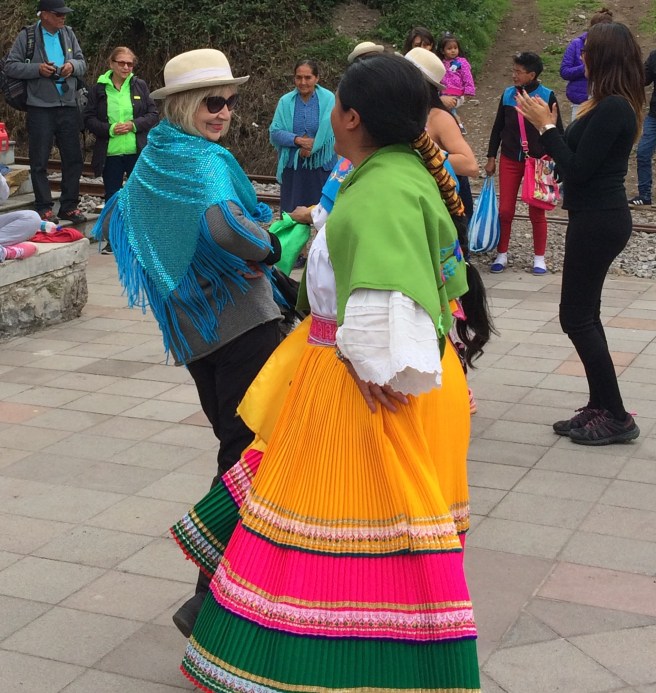
The highlight of the trip was the stop in Machachi. We disembarked the train and were escorted to a platform in front of the station. There a group of local dancers performed folk dances. After their performance members of the audience were asked to join in. You know me! I couldn’t resist. A dancer tied her scarf around my shoulders and put her hat on my head. Then we started dancing. The music was beautiful. The dance was a little like belly dancing without so much belly and hip action. Dancing when you are 10,000 feet above sea level leaves you winded!

image

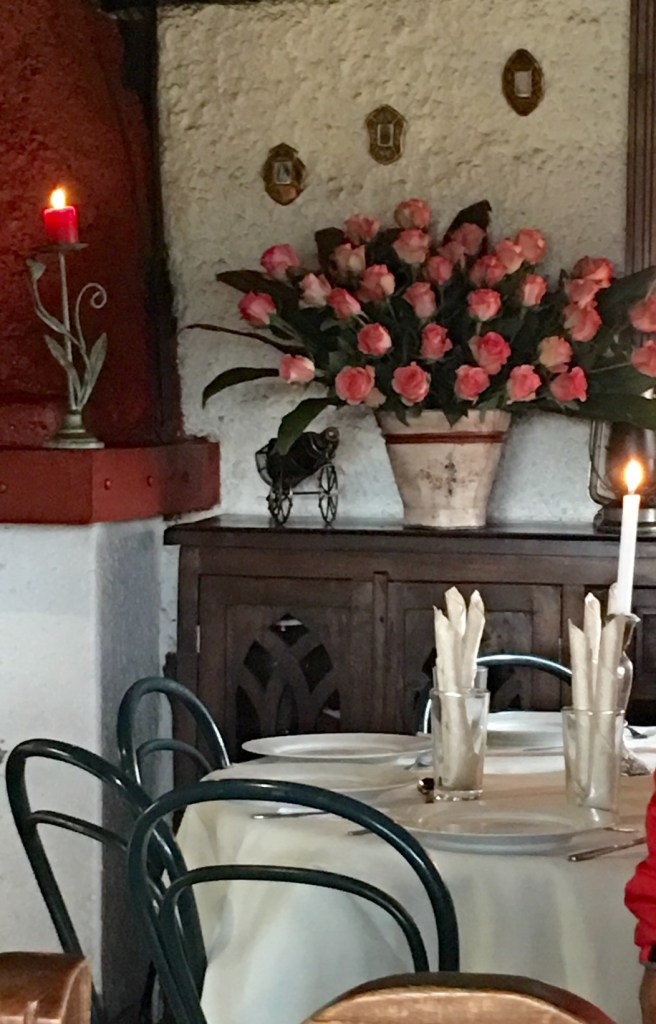
Once I caught my breath we followed our tour guide, Veronica, to the building where lunch would be served. I was expecting a sandwich in a cafeteria. We walked through a quaint courtyard filled with flowers and entered Hosteria La Estacion. My jaw dropped! We were in the most rustic and beautiful restaurant I have ever seen. Fresh roses adorned every surface, linen tablecloths, fine china, candles, and local artifacts made me feel as if I had been invited into a gracious Spanish home. The food was locally sourced, simply prepared, and delicious.

img_8523

The host only spoke Spanish, but I managed to understand that we were dining with people from Costa Rica, Peru, Argentina, Mexico, and Canada. Mark and I were the only U.S. Citizens. We were sitting with Susan and Bill from Canada. To minimize Trump inquiries we pretended we were Canadians too.

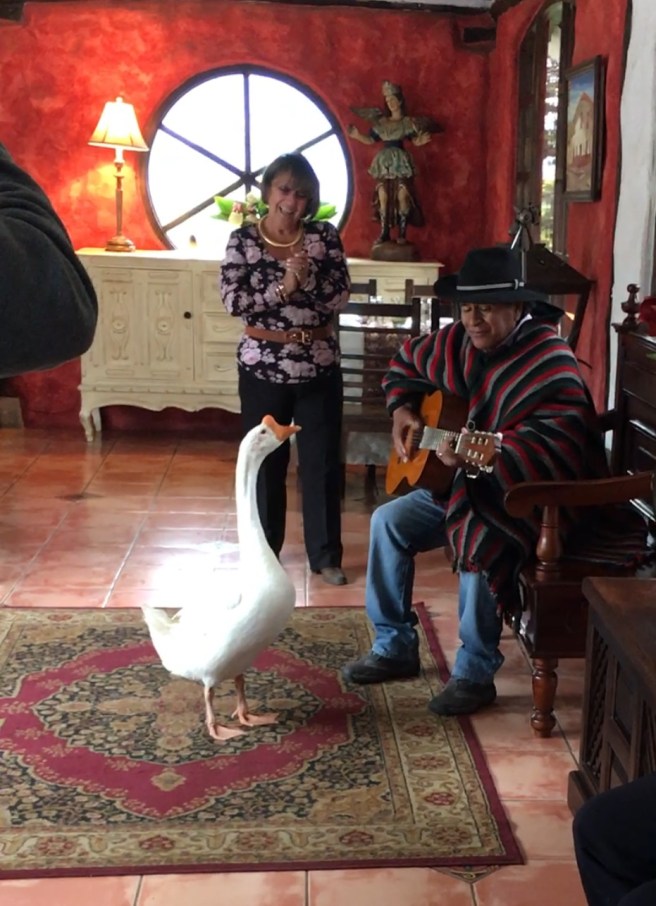
After dinner the host, Panchito, led us down a cobblestone path to the farm. On the way we saw a young man exercising a $35,000 black mare. She was exquisite. Then Panchito called his goose. She came running and eventually climbed up on his shoulder.

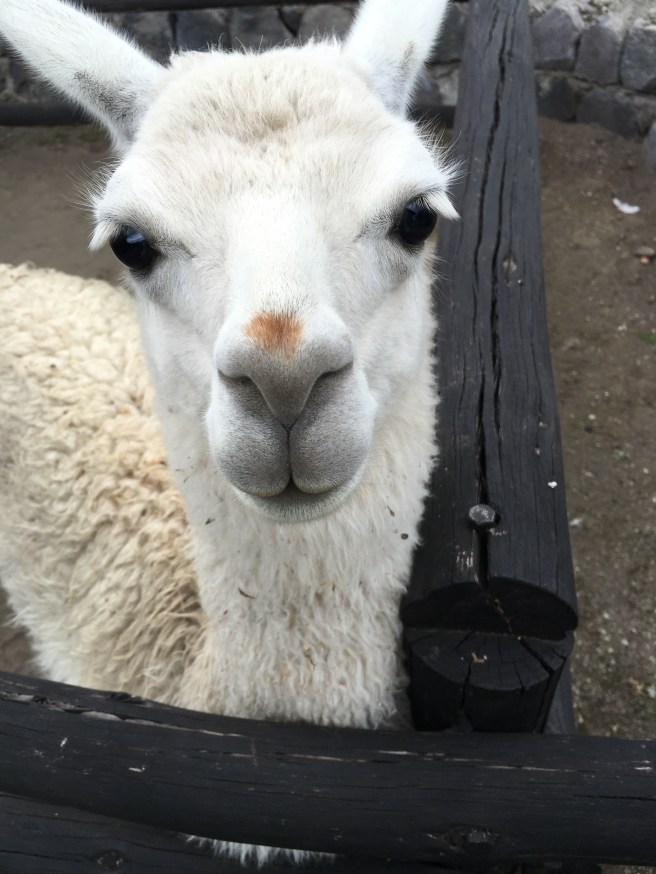
We followed Panchito and his goose to pens that held llamas, goats, dairy cows, sheep, a miniature horse, and water buffalo. The baby llama was my favorite. It wouldn’t stop nuzzling me. It wanted its ears scratched.

img_8562

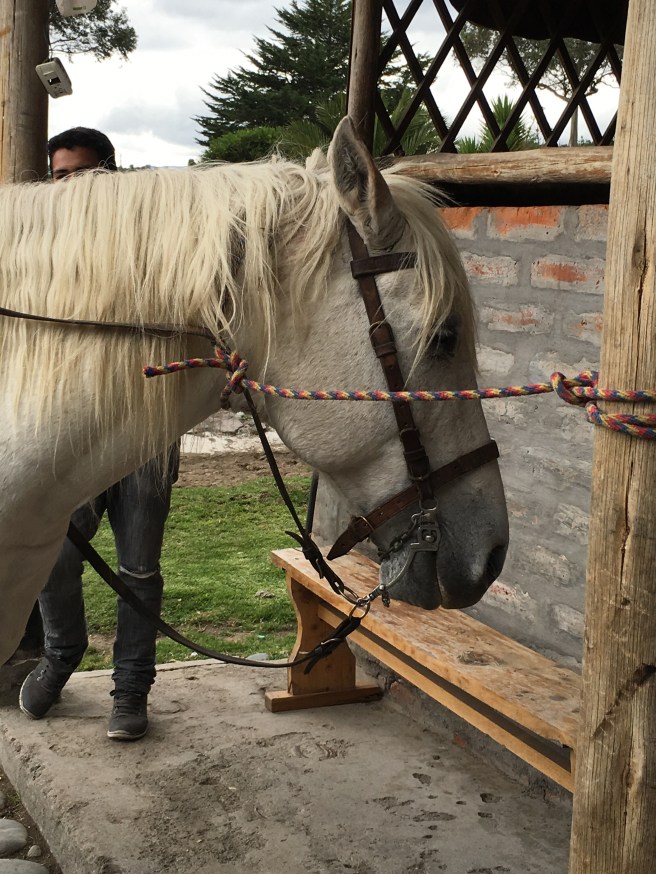
We were then lead into a small courtyard. As we turned the corner my heart nearly stopped! There saddled up and ready to go was a dead ringer for my old horse Duke. As I approached him he tried to nip at me. He not only looked like Duke, he shared the same sassy attitude! He reminded me how much I miss horseback riding.

img_8580

The grand finale was a serenade with Panchito and the goose. The children in attendance were delighted when the goose pooped on the elegant handwoven rug!

img_8825

We boarded the train back to Quito. I ordered a cold cerveza. With a smile of satisfaction I watched the countryside roll by.

image